Gold at GECCO 2023: Star Discrepancy Computation, High-Dimensional Track
First place in the high-dimensional numerical track of the GECCO 2023 Star Discrepancy Competition, where the search space grows so large that most exact methods stop being an option.
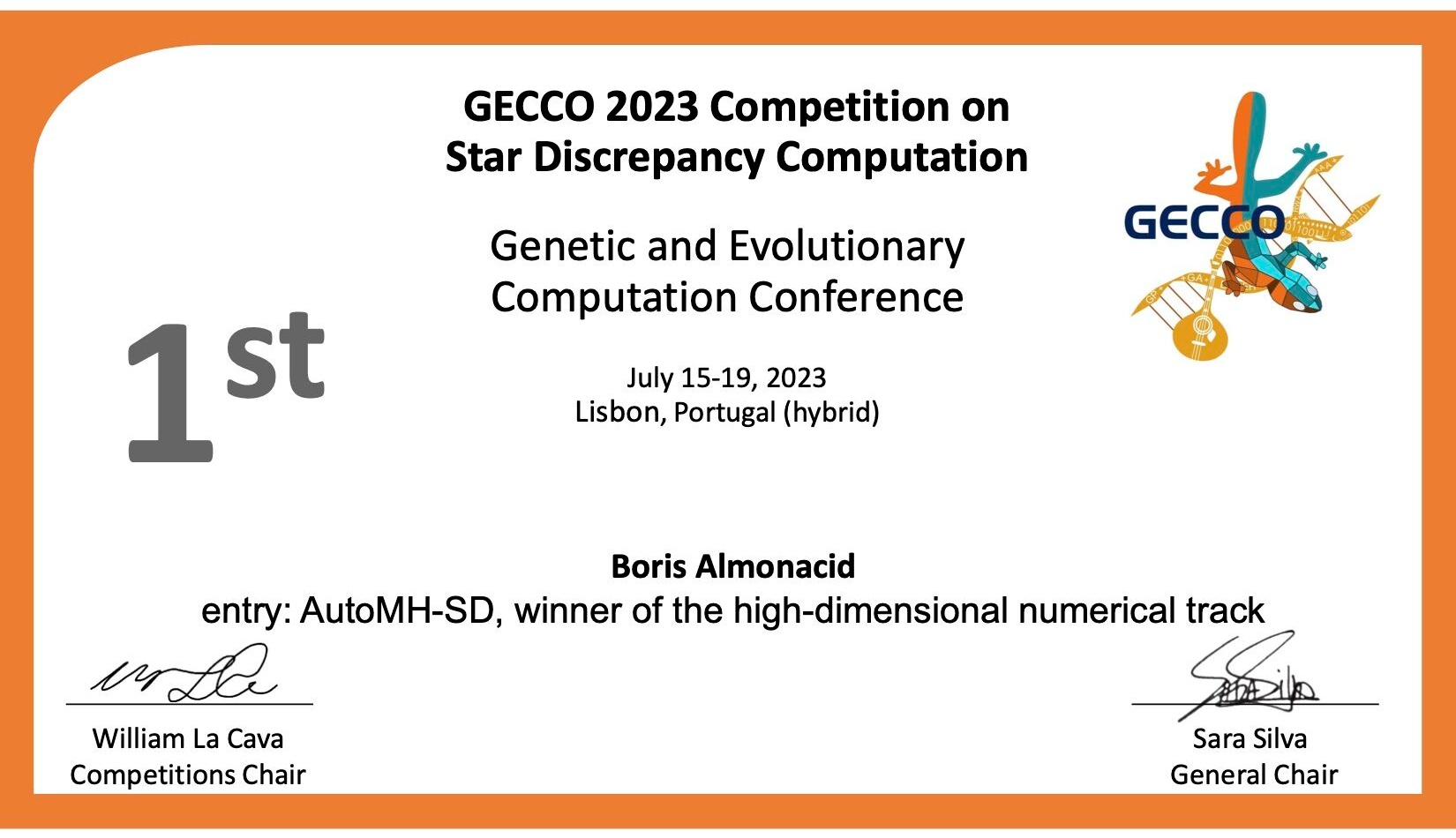
Official GECCO 2023 award certificate — entry AutoMH-SD, winner of the high-dimensional numerical track.
Gold — GECCO 2023 Competition on Star Discrepancy Computation, High-Dimensional Numerical Track.
The GECCO 2023 Star Discrepancy Competition, organized by Carola Doerr, Francois Clement, Diederick Vermetten, Jacob de Nobel, Alexandre D. Jesus, and Thomas Bäck, split entrants across tracks by dimensionality — because the L∞ star discrepancy of a point set gets combinatorially harder to pin down as the number of dimensions climbs, to the point where brute-force and even most structured solvers stop being an option.
The high-dimensional numerical track is where that trade-off bites hardest: point sets living in dozens of dimensions, where the “obvious” search strategies break down and a good metaheuristic has to do real work to find where the point distribution is thinnest. The winning entry, AutoMH-SD, applied the AutoMH framework — reinforcement learning generating evolutionary metaheuristics — to the continuous star discrepancy problem. The source code and experiment data are published on Figshare.
Winning gold there — separate from Angel Nasev and Borjan Peovski’s win in the low-dimensional track — was an early signal that the search strategies developed for this kind of geometric optimization scaled where it mattered.
It’s also the result that came a year before two more wins at GECCO 2024 — the first data point in what turned out to be a pattern, not a fluke.